


Your slowest runs shouldn’t feel like your hardest ones. If they do, your form is costing you heartbeats on every step.
Hey runners, how’s it going?
The first time I tried running slow on purpose, I took it to our local lake path. You know the one. Half the town walks it, and everybody sees you.
I was putzing along, trying to keep my heart rate down, and a baby stroller passed me. Then a guy walking his dog. Embarrassed? Yes. Humbled? Absolutely.
Getting passed bugged me less than how bad it felt. Every step was awkward and choppy. My heart rate kept creeping up even though I was barely moving. I’d been running ultras for years, and suddenly I couldn’t jog slowly without fighting it.
When I finally looked at what my body was doing, I didn’t like what I saw. I was bent forward at the waist. My foot was landing way out in front of me. My cadence was low.
I see the same thing in almost every older runner who starts slowing down with me. Running slow feels awkward and choppy because of poor running form. The good news is that form is fixable, and one short video shows you exactly what to fix.
Here’s why your form slows you down, how to get it checked, and what to do while it improves.
Bending at the waist puts on the brakes
When you bend forward at the waist, your hips drop back behind your shoulders. To keep from tipping over, your foot reaches out and lands ahead of your center of gravity.
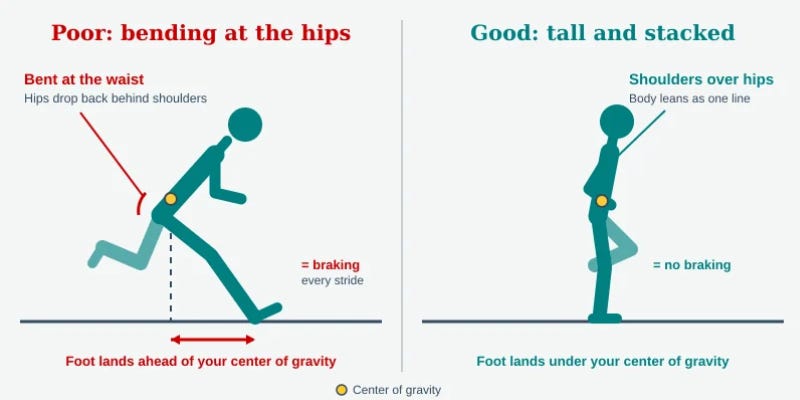
That’s essentially tapping the brakes with every stride.
Each time your foot hits the ground in front of you, your body has to stop, absorb the hit, and push itself forward again. Your legs repeat that work thousands of times per run. More work burns more oxygen, and more oxygen means a higher heart rate at the same slow pace.
The research lines up with what I see on the trail. A 2015 review of running economy explains that strides that are too long create a foot strike with large braking forces and cost more energy.[1] At the University of Wisconsin, Bryan Heiderscheit’s team had 45 recreational runners raise their step rate by 10% at the same speed. Their stride got shorter, their braking dropped, and their knees and hips took substantially less load.[2]
For us older runners, that matters twice. A higher heart rate makes it harder to stay in your aerobic zone, and the extra pounding lands on joints that have been at this for 40 or 50 years.
Here’s a quick check. On your next easy run, look at your Garmin. If your heart rate won’t settle under 130 bpm at a pace that feels embarrassingly slow, your form is a likely suspect.
You can’t see your own form while you’re running. That’s why the next step is a camera.