


Hey runners, how’s it going? As an older runner, do you like to enter a race occasionally? And do you find yourself struggling through your race training plan — feeling tired and sore all the time, maybe even picking up an injury along the way?
You’re not alone. I’ve run into that wall several times over the last few years. Trying to squeeze in speed work, a tempo run, and a long run with easy days sandwiched between is honestly a lot to ask of this old body. I remember finishing a hard Tuesday interval session and heading out Wednesday feeling like my legs were made of concrete. Something had to change.
That’s when I discovered an alternative approach to race training that works really well for older runners like us.
The Problem with the 7-Day Training Week
The main problem with 7-day weekly race training plans is they’re built around calendar convenience — not how our older bodies actually respond to hard workouts.
I’m sure you’ve felt this yourself. As older runners, we deal with slower muscle repair, increased tendon stiffness, and longer nervous system recovery after hard efforts. What took a day to bounce back from at 40 now takes two or three days at 60 or 70.
That’s why cramming three hard workouts into a seven-day window doesn’t give us sufficient recovery. We end up stiff, sore, and tired going into the next session. And our body doesn’t care what’s on the training plan — if you’re not recovered, you’re opening yourself up to pain and injury, a subpar race result, or worse, missing the race entirely.
How I Found the 9-Day Cycle
About a month ago, a YouTube video popped up in my feed explaining a different approach to race training — a 9-day cycle rather than the standard 7. I immediately saw the benefit for older runners like us.
Now, I’ll be honest — I haven’t tried this yet myself. I have good time flexibility since I’m retired, and I plan to give it a go this spring. But what caught my attention was how perfectly it aligns with everything I’ve learned about recovery over 20 years of running and two heart attacks. Three hard workouts per cycle, with a rest day after each one, giving your body the recovery time it actually needs.
Let me show you how it works.
✱ Click to Watch on YouTube
✱ Click to Listen to the Podcast
How the 9-Day Cycle Works
The 9-day cycle builds in a rest day after each hard effort. Most conventional 7-day plans have you stacking runs right after a hard workout, leaving you grinding through sessions on tired legs.
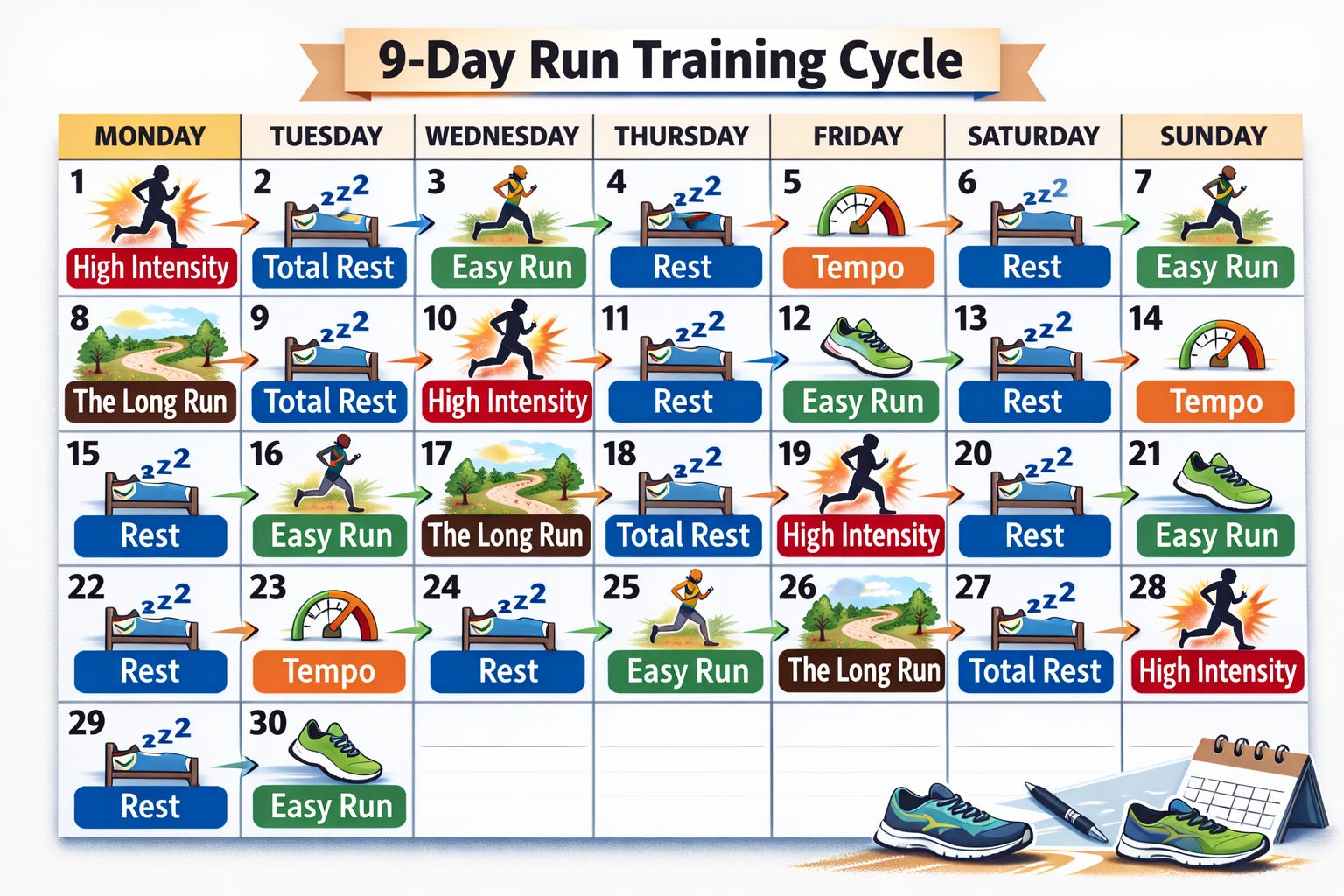
Here’s what a single cycle looks like:
The 9-Day Cycle
Day 1 - High intensity
Day 2 - Total rest
Day 3 - Easy run
Day 4 - Rest
Day 5 - Tempo run
Day 6 - Rest
Day 7 - Easy run
Day 8 - Long run
Day 9 - Total rest — then repeat
Notice that as the cycle rotates through the month, different days of the week get different workouts. That’s intentional. Your body dictates the schedule, not the calendar.
As a result, you’ll have higher quality workouts because you’re fully rested — attacking each session fresh rather than just surviving it. You’ll get through your entire training plan without the constant pain, soreness, and stiffness that derails so many older runners before race day.
Performance isn’t built by stacking fatigue — it’s built by absorbing work.
“But My Schedule Won’t Allow It”
I know what you’re thinking — “That sounds great, but my life doesn’t work that way.” Most of us build our week around weekend long runs, especially if you’re still working a regular job.
Here’s my honest answer: if it’s important to you, you’ll find a way. If you’re retired like me, this should be pretty manageable. If you’re still working, look for flexibility where you can find it — early mornings, lunch runs, shifting your long run to Sunday instead of Saturday.
If you run with a weekly group, just adapt. Some days you’ll be pulling the front, some days the rear, and occasionally you skip the run and just meet for coffee. That’s fine. Your community is just as important as your training.
You won’t lose fitness or sharpness making this shift. The quality of your workouts will actually improve because you’re finally fully rested when it counts.
Train Smart, Live Longer
The 9-day race training cycle fits perfectly with my run smart, live longer philosophy. The most common mistake older runners make isn’t lack of effort — it’s not allowing enough recovery. We’ve been training like we’re 35 when our bodies need us to train like the experienced, wise athletes we actually are.
What do you think? Try laying out what your current race training schedule would look like converted to a 9-day cycle and drop it in the comments. I’d love to take a look.
Want personal help building your race training plan?
Click Here to Join the Free Forever Running Club →
Have a great week!
–Herb
“Run Smarter, Live Longer”